Michael Sappol, with Evi Numen
1
Hello readers! I’m a historian of anatomy and “the Body”. My most recent book (now a year old, and just starting to walk and talk) is Queer Anatomies (Bloomsbury, 2024). It’s belated work, should’ve been written 30 years ago when queer theory was having its formative moment. Today, it goes against the grain. Current scholarship tends to focus on anatomy’s role in the formation of racial and gender science, and the nonconsensual appropriation of bodies, paired with demands for reparative justice. Had I been following the trend, Queer Anatomies would have mucked around in all the bad things that scientific medicine did to people from queer and other victimized groups: anatomy’s penchant for pathologizing deformity, racial difference, and sexual deviance; anatomy’s penchant for naturalizing the heteronormative gender binary and “normal” (white, healthy, masculine) bodies.

Indeed, last year when we announced the publication of Queer Anatomies online, a friend from the distant past popped up on Facebook to wonder whether the book would be “a history of medical disenfranchisements of the gendered and sexual Other…” The quick answer was “no”: Queer Anatomies is about perverse desire and pleasure in anatomy. Queers queering anatomy. And not anatomy anatomizing queers….
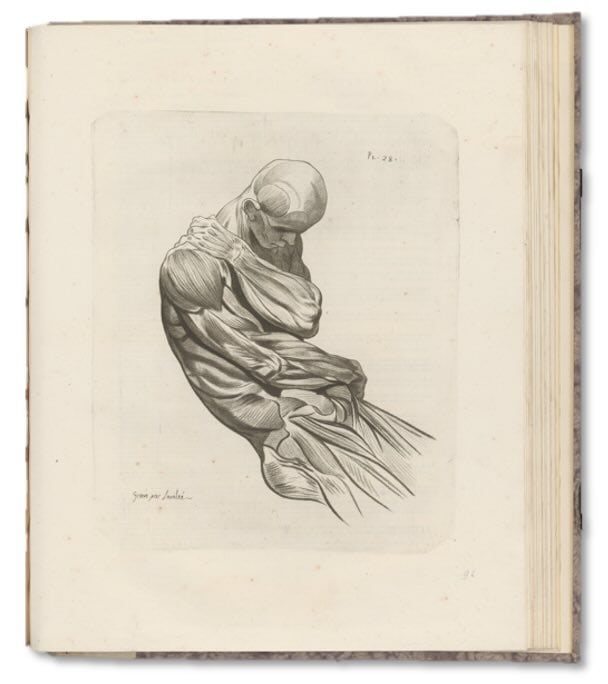
How so? Well, sexual body parts and same-sex desire were unmentionables in 18th- and 19th-century Europe, debarred from polite conversation and printed discourse. Yet one scientific discipline, anatomy, had license to represent the intimate details of the human body—rectum and genitalia included. Performed by the figure of the dissected or flayed cadaver, the anatomical division of the body into bounded regions and systems could be soberly technical. But just as often monstrous, flirtatious, theatrical, beautiful. And sensual. Anatomical images gave off heat, an erotic frisson which pleasured the men who produced and gazed upon and collected anatomical atlases and prints. Even better: anatomy was a foundational subject in art, as well as medicine, and it had a privileged status in the encyclopedic curriculum of Enlightenment discourse. And thus anatomy offered the protection of plausible deniability: Philosophical, medical and aesthetic competence, all depended on a secure knowledge of the body. Which was largely the anatomy of Man, all naked and muscular, even if flayed or dissected. A masculinist domain. A masculinist story. Our historical actors—male anatomists, artists, bibliophiles, connoisseurs—didn’t openly declare their erotic interests. Because even if sex between men was common—the 18th- and 19th-century world was full of sex-segregated work, living and play spaces that nurtured queer desires and attachments—same-sex interactions and gender play were stigmatized. Theologically and juridically prohibited. Penalties were severe: execution, flogging, incarceration, fines, deportation, or just shunning and public humiliation. Outside of certain privileged or sequestered domains (nude sculptures in the idiom of homoerotic classicism), there could be no open expression of same-sex pleasure or desire, no texts or images that explicitly represented or incited such things.
Understandably then, our historical actors tried to cover their tracks. Or speak in code. If their “closeted-ness” was “a performance initiated…by the speech act of a silence” (Eve Kosofsky Sedgwick, The Epistemology of the Closet, 1990), we only get them if we enter deeply into their textual and representational spaces, and imaginatively decode what they left behind. Which is why Queer Anatomies features close readings of images that were originally presented in celebrated, very respectable anatomical atlases, as well as images that appeared in works that danced on the borderline of respectability. The queerness was in the images. Under cover but flagrant.
2
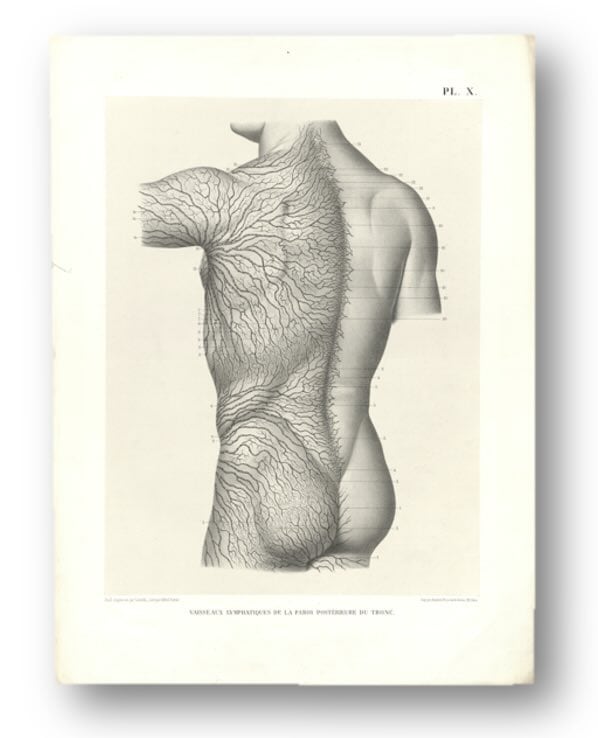
Queer Anatomies has many arguable propositions, so many that I originally titled it “The Epistemology of the Anatomical Closet.” (My editors shut that down.) The central proposition: queerness was in the center of the anatomical illustration, and in the center of European civilization and culture. Not just the margins. Patriarchy, heteronormativity, generated gender trouble, queer attachments. And the anatomical illustration, especially the illustration of male genitalia, rectums, and buttocks, was a representation, expression and vector of queer. Hidden in plain sight.
Maybe you’re now thinking: Anatomy? Really? Anatomy may now seem somewhat obscure. But once upon a time, anatomy multi-tasked, did all sorts of important cultural work. Its remit was the human body, and differences within and among bodies. The difference between the living and the dead. Normal and pathological. Male and female. Dissectable and non-dissectable. White and colored. Human and animal. Anatomy inscribed and policed boundaries, yet continually transgressed and provoked, claimed a special epistemological professional exemption from strictures that customarily governed sex and death.
One other thing, connected to anatomical provocation: Anatomy was “between men” (the title of Eve Kosofsky Sedgwick’s 1985 foundational text of queer theory). Dissecting rooms, anatomical theaters, and medical associations were clubby secretive sites of male sociability. Medicine was a fraternity of dissectors. Anatomical dissection was the ritual that initiated young men, often in their teens or early 20s, into the cult of professional medicine. And medical schools were notorious for being more than adjacent to scenes of drunken riotous pranksterism and – given student enthusiasm for anatomy and the shortage of legally supplied bodies – bodysnatching. To the great annoyance of surrounding communities. (“Town versus gown.”)
3
After Queer Anatomies was published and ready to meet readers, I took it on the road. And had the great pleasure of visiting sites that had their own history of anatomical queer. Such as the Old Anatomy Museum at Trinity College, Dublin, a true and precious relic of the many phases that medicine and anatomy went through from the 18th century to the middle of the 20th. Curator Evi Numen generously invited me to lecture there and do a few days of exploratory research. Which paid off with a discovery that opened a small window into how Dublin’s anatomy professors and students encountered the drawings of Joseph Maclise (1815-1891).
Maclise, a native of County Cork, Ireland come to London, and a brilliant anatomist and artist, takes up residence in the last third of Queer Anatomies. Because he had a queer penchant for making sensual drawings of beautiful young men with beautiful (but very dissected) bodies. And for representing their genitals and grazing hands, even when those body-parts were entirely irrelevant to the anatomical lesson at hand. (Other illustrators of the period covered genitalia with cloth or some other device, or omitted them altogether.)
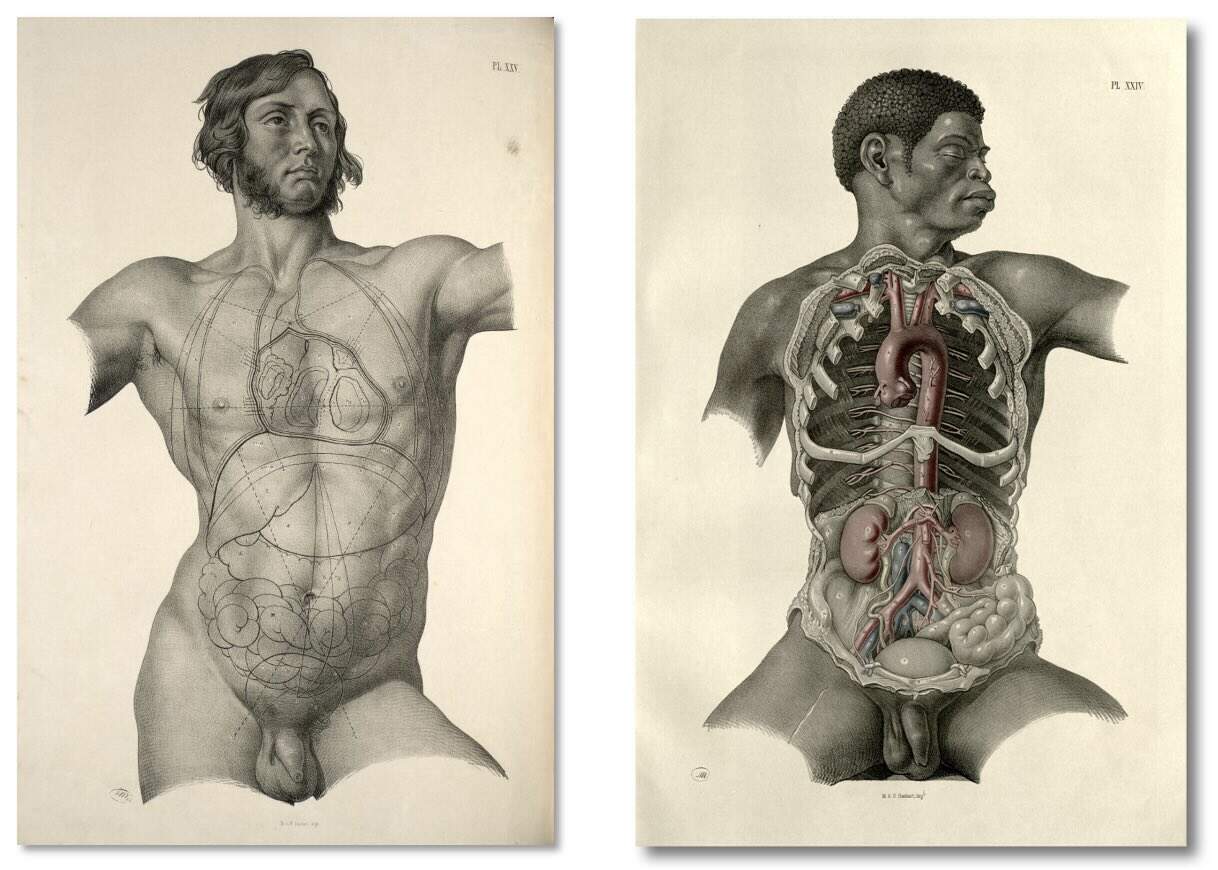
In the era of free-floating digital media, we customarily detach images from their material and social context, and then manipulate and repurpose them. So in Queer Anatomies, where possible, I tried to show the edges of the page and books open to a page, to remind readers that anatomical illustrations lived on paper, in books and folios which were material objects, which in turn lived in library collections, alongside objets d’art and other collectibles. Rare and expensive anatomical atlases were often the prized possessions of bibliophilic collectors. If anatomized nudes and body-parts were fetishized objects of desire, so were the books and prints in which they appeared. There was a double frisson, double desire.
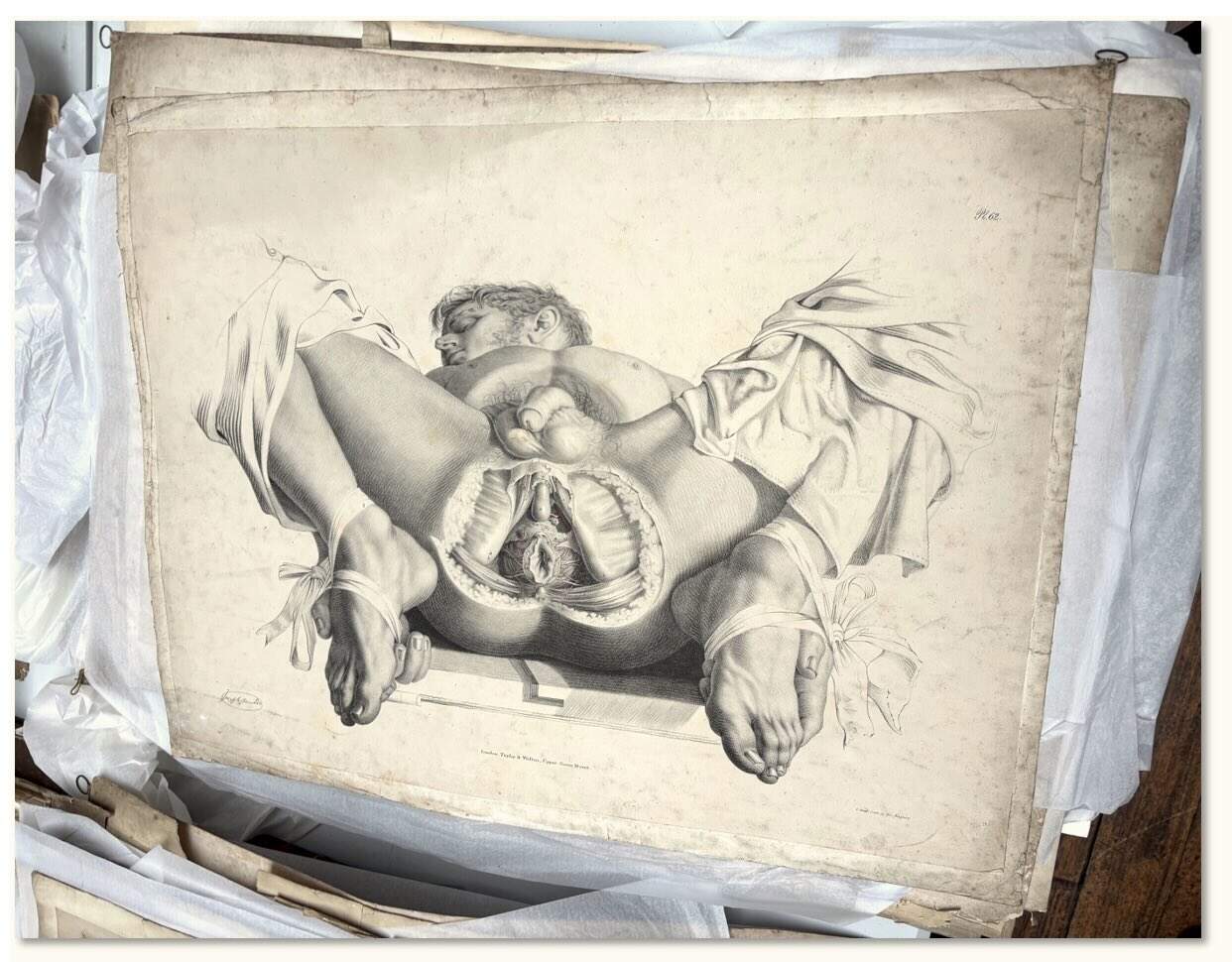
But our research in the Old Anatomy Museum forcibly reminded me that anatomical images also lived outside of books, as working images in the service of medical pedagogy. Because, amidst the specimens and models of the museum, we found rough, uncatalogued printed materials, covered with dirt and spatter. And among them: lithographs extracted from books and folios, mounted on linen, equipped with hooks at the corners (fig. 6). (Think of it as an earlier stage of media-culture image manipulation and repurposing.) The professors hung Maclise’s sexy men in the anatomical theatre and dissecting rooms, where students could consult them for reference, perhaps with the aim of trying to inspire the students to make their dissections and specimens look as artful—as beautiful—as the ones Maclise so artfully dissected and drew on paper.
In Between Men, Eve Kosofsky Sedgwick argued that we need to situate homoerotics in the wider context of 19th-century homosociality, where groups of often sex-segregated men went through a spectrum of dynamically reversable attachments and emotional interactions ranging from open and closeted homoerotic desire to panic and homophobia. In Queer Anatomies, I looked for glowing hints of a similar dynamic in the man’s world of anatomy and anatomical imagery.
Trinity College Medical School was part of that man’s world (women only gained the privilege of admittance in 1907). The rest of the college functioned as an elite school for students from respectable families, but the medical school, located right next to Dublin’s red-light district, had a less savory social character. College authorities tried to manage that by building a gate to protect regular students from the disreputable medical students.
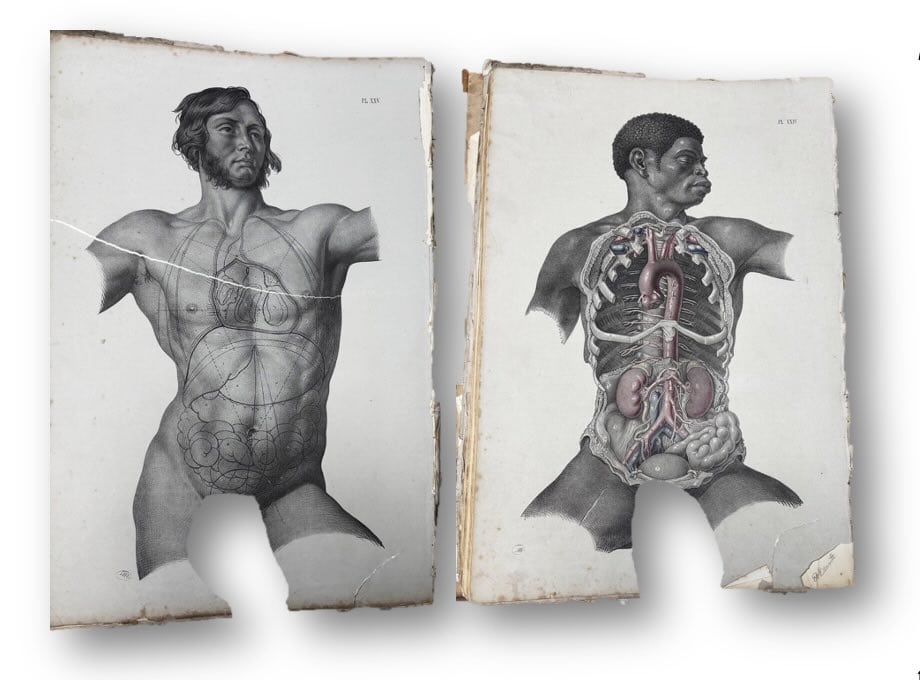
A final point: in that pile of soiled dissecting-room lithographs, Evi and I found two altered images (fig. 7). Figures 4 & 5 show them as they appeared in the pages of Maclise’s Surgical Anatomy (1856). The two plates, like figure 6 and many other plates at the Museum, had been removed from the printed book and mounted on paper. But these two were vandalized. In a very particular way. (Call it a secondary instance of print-culture image manipulation and repurposing.) Why, we don’t know: we didn’t find any textual evidence pertaining to the vandal’s motives, or reactions to the vandalism, if any there were. We can only speculate. Likely it was a case of impulsive homophobia, rough censorship, an expression of panic or disgust. But it’s also possible that someone extracted the drawings of male genitalia for private, pleasureful viewing. So: a case of queers queering anatomy? Or symbolic queer-bashing? Either way, prompted by the homoerotic valence of Maclise’s anatomical illustrations …
Of course, even to pose the questions, you have to be sensitized to the queerness. Queer Anatomies argues (again following Eve Kosofsky Sedgwick) that we ought to speculate. When we’re trying to understand a world of heavy-handed gender policing and closeted desire, if we refrain from speculation we miss the whole show.
But, apart from erasure and opacity, there’s also the erosive power of time. As it stands today, the Old Anatomy Museum, a 19th-century building full of specimens, models and equipment, is a bit like Schliemann’s Troy, with one layer of anatomical /surgical /pathological research and pedagogy piled on top of another, a succession of weathered fragmented “orders of things” going from the 1700s to the 1970s. The old vitrines hold lots of great stuff, but in dark dusty closets and drawers, and beneath the benches of the anatomical theater, stashed away long ago, there are many more treasures, with ghosts in attendance. Someday in the not-so-distant future, that haphazard scatter of objects will be superseded by state-of-the-art exhibition design, modern storage, and up-to-date captions (along with the preserved original labels), the Old Anatomy Museum will host an institute for medical history and heritage, and become a much-visited and much-beloved historical attraction of Dublin – curator Numen’s long-range goal. But right now the Museum, full of neglected relics, is itself a neglected relic, a precious portal into anatomies past. And, sure enough, queer anatomies.


NOTCHES: (re)marks on the history of sexuality is licensed under a Creative Commons Attribution-NonCommercial-NoDerivatives 4.0 International License.
Based on a work at www.notchesblog.com.
For permission to publish any NOTCHES post in whole or in part please contact the editors at NotchesBlog@gmail.com


