Laura Horak
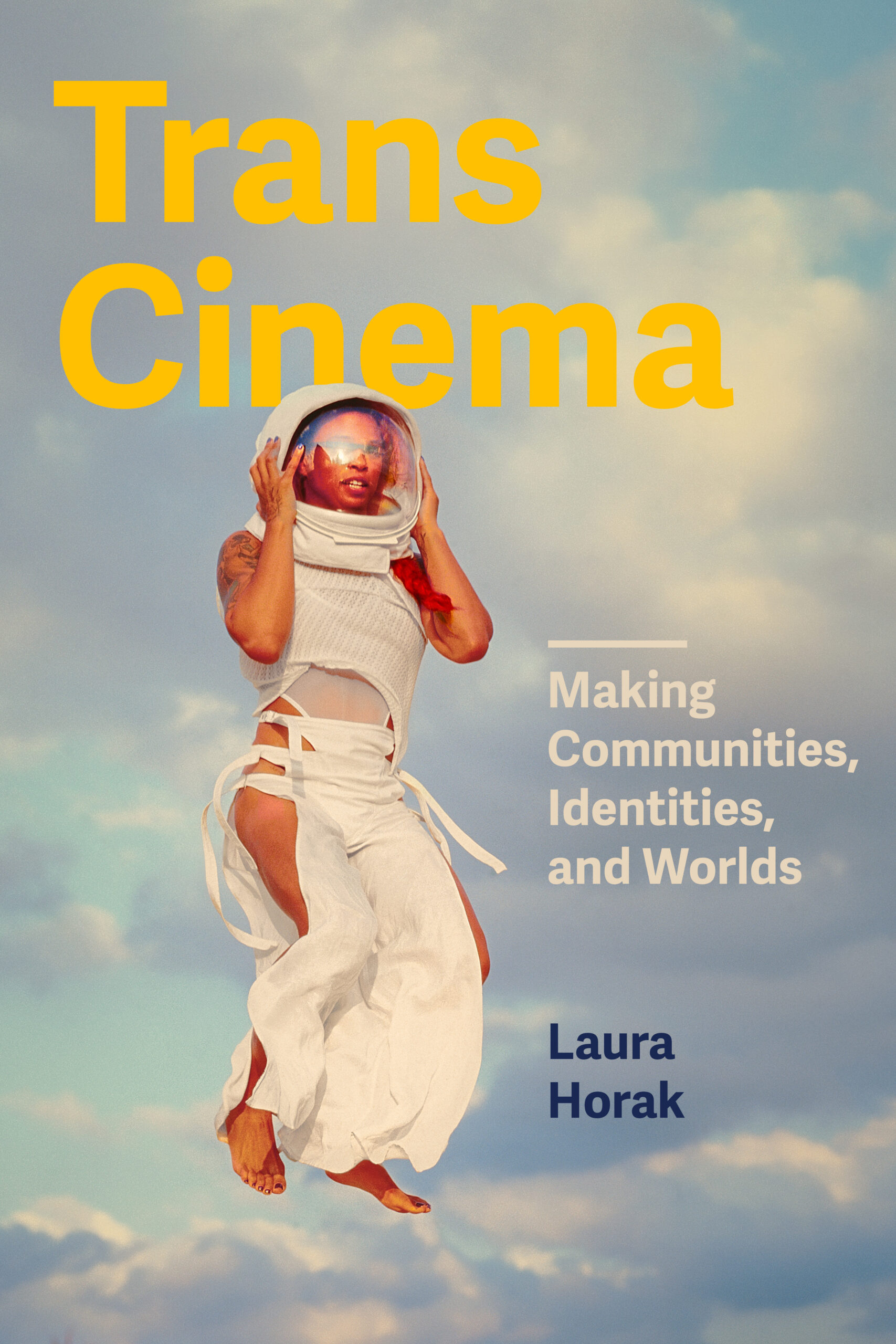
Mainstream media and politics have the tendency to represent transgender people through a handful of clichés—villains, punchlines, or victims. But when trans people themselves get behind the camera, they present a whole spectrum of complex personhood, using the tools of a huge range of genres, from horror to romantic comedy. Most people don’t know that trans people have been creating films for decades—these films are just hard to find. Trans Cinema: Making Communities, Identities, and Worlds introduces the aesthetic and generic innovations of trans creators in the US and Canada—with a focus on BIPOC trans creators—from the 1990s to today. It explores the different ways that trans filmmakers have taken on a series of core human experiences, from being in community, to childhood and parenthood, to love and dating, resisting police and violence, having a body, and connecting to the past.
NOTCHES: Why will people want to read your book?
Laura Horak: The book is designed to be accessible to the general public. I designed it along the lines of my Transgender Cinema seminar, where each chapter is a week of class, and each chapter ends with suggestions for recommended screenings and readings.
Anyone who’s interested in trans life, or filmmaking from the margins, or innovative low-budget filmmaking should read this book.
NOTCHES: What drew you to this topic, and what questions do you still have?
LH: As a film nerd and cis queer person growing up in Portland, Oregon, in the 1990s, and living in San Francisco in the early 2000s, I witnessed the newly popularized concept of “transgender” attracting exciting new political efforts and creative work. I knew that great trans films were being made and shown at film festivals throughout this time. And yet, in the 2010s, when I was trying to put together a lecture on the topic, I couldn’t find anything written about these films or festivals. I even asked one of my mentors, the great trans historian and filmmaker Susan Stryker, where to find this writing and she said it didn’t exist. That’s when I knew I wanted to work on this topic.
The first thing I did, actually, was get some funding and put together a lab, the Transgender Media Lab, which then created the Transgender Media Portal (transgendermediaportal.org). The Portal is like IMDB but for trans filmmakers and their works. We now have more than 1,300 film titles and more than 1,000 filmmakers. You can use filters to find the specific kinds of films you’re interested in, made by filmmakers with specific intersections of identity.
But the Portal can be overwhelming! And it only offers so much context for each film and filmmaker. That’s why I wrote the book. It uses the core tools of Film Studies—close formal analysis and historical contextualization—to introduce some of my favorite trans-made films to readers, to better understand how trans creators have innovated audiovisual media to make works that completely exceed mainstream media.
I still have plenty of questions, though! In fact, my new research is on how arts institutions like funders, festivals, and distributors enabled (or prevented) trans filmmaking in specific regions of the US and Canada from the 1990s to today. I want to learn from that—and from interviewing contemporary trans filmmakers—how these institutions can better support diverse trans filmmaking today. And then convince those institutions to make those needed changes. And because my research focuses on BIPOC trans filmmakers, when institutions change to better support them, they in fact better support everybody.
NOTCHES: How did you research the book? Were there any especially exciting discoveries, or any particular challenges?
LH: I mentioned that trans-made films of the last several decades become hard to find after their festival runs. So how did I find them? One of the most useful primary sources for me has been transgender film festival programs. The first multi-year transgender film festivals were founded in 1997 in Toronto, London, and San Francisco. Amazingly, the San Francisco festival is still going! Later, major festivals were founded in Seattle, Minneapolis, and Amsterdam. Some programs exist as pieces of paper in archives and many only as websites or PDFs. These programs have provided most of the film titles in the Transgender Media Portal. When my lab adds a film title to the Portal, they also research the filmmaker and try to find a URL to view or rent the film, so that users can access the film as easily as possible.
I try to watch as many trans-made films as I can and when I find one that’s particularly compelling, I add it to one of my courses. The films that work really well in teaching are the ones that ended up in the book.
NOTCHES: Whose stories or what topics were left out of your book and why? What would you include had you been able to?
LH: Initially, I wanted the book to cover films by intersex creators, as well. I do have a section about intersex politics and filmmaking in the chapter on “Embodiment and Transition,” but I kept it short. There are important overlaps in trans and intersex experiences and political movements, but they are not the same. I felt that I couldn’t do intersex filmmaking justice in this book. But I would love for more research on that topic to be done.
NOTCHES: Did the book shift significantly from the time you first conceptualized it?
LH: Well, the main shift is that I thought it would be a short book that I would write in a year and it’s now a 401-page book that I wrote in 6 years. Because I want the book to be accessible to people with no background in transgender studies or film studies, there was a lot I needed to explain about trans history and politics and film studies approaches to genre and form. And I wanted to show how vastly diverse trans filmmaking is and that meant including films that were as different as possible in each chapter, so I went from my initial idea of two feature films per chapter to a mix of features, shorts, and web series in each chapter.
The other main shift was that when I started writing the book in 2020, there was already a lot of political backlash directed at transgender people, but now, when the book is finally being published, in April 2026, things are so much worse for trans people, especially in the United States. President Trump’s executive orders claim that there are only two sexes and no one can move between them, and that affirming the felt genders of children and youth is a form of child abuse. People are having their names and IDs declared fraudulent, their health care taken away, their ability to use washrooms in public attacked, and their ability to play sports on a recreational or professional level removed. Many states are telling K-12 schools and universities not to teach about “gender” or “race” or even “culture,” let alone about the realities of trans lives and histories.
While film might seem a luxury compared to the life and death things that trans people are fighting for right now, I think it’s all the more important for trans people (and their allies) to access these works. These films show that they are not alone and that trans people have been fighting and surviving for a very long time and that we can still imagine new worlds together.
NOTCHES: How do you see your book being most effectively used in the classroom? What would you assign it with?
The book is designed as an 11-week Transgender Cinema seminar, with suggested readings and screenings each week. But it would work just as well in courses in fields like LGBT Studies, Women’s and Gender Studies, American Studies, Cultural Studies, History, and Film and Media Studies. The chapter on “Love, Sex, and Dating” explores how cinema can construct desiring trans gazes, so it would work well in a week on the gaze and Laura Mulvey’s “Visual Pleasure and Narrative Cinema.” The chapter on “Resisting Violence, Police, and Prisons” could work in a class analyzing the violence of ICE and anti-Black police brutality in today’s political context.


NOTCHES: (re)marks on the history of sexuality is licensed under a Creative Commons Attribution-NonCommercial-NoDerivatives 4.0 International License.
Based on a work at www.notchesblog.com.
For permission to publish any NOTCHES post in whole or in part please contact the editors at NotchesBlog@gmail.com


