Michael Hall
This post expands the author’s recent book A Queer Inheritance: Alternative Histories in the National Trust and his analysis of Clouds Hill as a queer place with an interpretation of the furnishing of Lawrence’s bookroom.
After T.E. Lawrence was killed in a motorcycle accident in 1935, at the age of only forty-six, his home at Clouds Hill was given by his family to the National Trust in memory of one of the most famous Englishmen of his age, known throughout the world as ‘Lawrence of Arabia’. Hidden among pine trees and rhododendron bushes in the sandy south Dorset heathland just outside Bovington military camp, where in 1923–25 Lawrence had served anonymously in the ranks, the little cottage quickly became a place of pilgrimage for his admirers. This was partly thanks to the appearance soon after his death of the first public edition of his masterpiece, Seven Pillars of Wisdom, the account of his participation in the Arab revolt of 1916–18 that helped secure victory for the allies over the Ottoman empire. Lawrence’s glamorous reputation, enhanced yet further when the book was filmed by David Lean in 1962 as Lawrence of Arabia, was not entirely good news for Clouds Hill. When James Lees-Milne, then secretary of the National Trust’s Historic Buildings Committee, visited in 1945 he wrote in his diary that it was ‘a pathetic little shoddy place. The visitors have stolen all they could lay their hands on’.

Clouds Hill is now unrecognisable from that description thanks to the careful repair of the interiors embarked on by the National Trust at the beginning of this century. The Trust’s restoration was timely, as it coincided with the removal of the last restrictions on public access to the principal Lawrence archive, in the Bodleian Library, Oxford. This has allowed, albeit to a hesitant degree, a fuller and more authoritative discussion of Lawrence’s queer sexuality, a subject that was for years dealt with by most of his innumerable biographers with a mixture of naivety, denial and barely disguised homophobia. Yet Lawerence liked to hide in plain sight. Just as a careful reading of his books and letters can leave nobody in serious doubt about the nature of his sexuality, so Clouds Hill, which he chose as a place where he could escape his celebrity, has much to reveal about his secret queer life. This two-up and two-down cottage is a monument of paradoxical intimacy for a man whose public reputation was defined by an epic military achievement.
In 1938, E.M. Forster, who had visited Clouds Hill several times, wrote that to think of it ‘as T.E.’s home is to get the wrong idea of it. It was rather his pied-à terre, the place where his feet touched the earth for a moment and found rest.’ Nonetheless, Lawrence dedicated considerable effort and money to making it suitable for the settled life that he planned for his retirement from the RAF, which he had joined after leaving the army in 1925. The cottage was reshaped in line with his idiosyncratic ideas about domesticity: ‘give me the luxuries’, he remarked in 1933, paraphrasing Oscar Wilde, ‘and I will do without the essentials’. The luxuries included a cork-lined bathroom where he could enjoy one of his greatest pleasures, very hot baths. The essentials he did without included electricity, a lavatory and a kitchen – he ate out of tins and never cooked. Upstairs there is a large music room and a small room that doubled as a food store and guest bedroom, which he lined with aluminium foil. Although there was a practical damp-proofing explanation for this, the silver walls evoke the world of 1930s theatrical glamour associated with, for example, Noël Coward. Although Lawrence knew Coward, whose works he admired, it’s possible that the silver walls were inspired by his unexpected friendship with Stephen Tennant (1906–87), the youthful gay epitome of the interwar Bright Young Things. Tennant was often photographed by his friend Cecil Beaton, whose best-known image of the young aesthete, taken in 1927, shows him against the backdrop of his bedroom in his parents’ London house, which he had lined with aluminium foil. It seems likely that Lawrence knew the photograph, which could therefore have given him the idea for his own silver room.
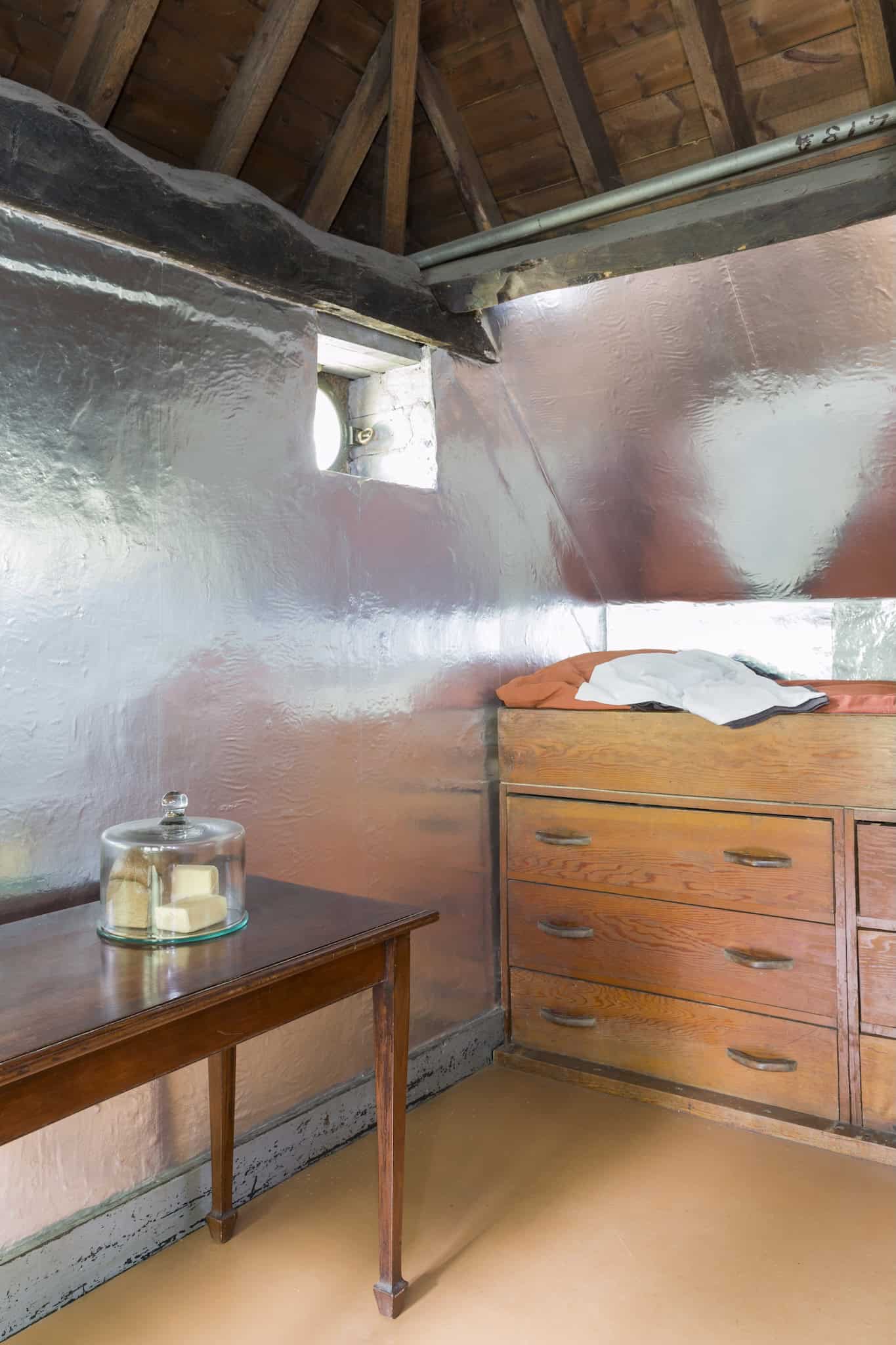
© National Trust Images/James Dobson.
Downstairs, the larger of the two rooms (the other being the bathroom) was fitted out as a bookroom. It is dominated by a large and somewhat mysterious piece of furniture, built into the wall below the window. Seemingly a bed, it did not have bedclothes (Lawrence slept in a sleeping bag, on the floor, or so he claimed) but is covered with leather. Lawrence initially had only a window seat constructed in this position, but in 1933 he wrote to K.W. Marshall, an unemployed bookseller who was staying at Clouds Hill to help arrange the books: ‘On the way down from London are also a cow-hide and a mattress. They are to add to the settee thing in the book room and make a proper lying place of it.’ What exactly did he envisage doing with it? It could of course be used for sleeping, but writing in November 1934 to a friend, Lawrence was emphatic that Clouds Hill had ‘no bed’. He gave the impression that he used the ‘lying place’ for reading, but that seems odd, as he also designed for the room an armchair intended specifically for reading, with broad arms that could support a book rest.

Knowledge of Lawrence’s sexual life suggests the ‘lying place’ had another purpose. In 1968 a former soldier from Bovington camp, a working-class Glaswegian named James (‘Jock’) Bruce (1905–71) revealed to the Sunday Times that in 1923, shortly after he had enlisted as a private in the Tank Corps, and while still in his late teens, he had been persuaded by Lawrence to beat him at Clouds Hill and that he continued to do so there and elsewhere at intervals over the next twelve years. There was unquestionably a dark side to this relationship since Bruce was induced to carry out the beatings by Lawrence’s expert grooming of the star-stuck youth, who believed that he was obeying the orders of an uncle of Lawrence who wanted his nephew punished for various short-comings. There was no uncle and the letters instructing Bruce to carry out the beatings were written by Lawrence as part of an elaborate masochistic fantasy. Devoted to a man who had supported his family financially and was godfather to his son, Bruce was adamant that Lawrence was ‘not homosexual’, despite the evidence of other men who beat him that he began by stripping naked and ejaculated at the conclusion.
Although Bruce’s testimony was not welcomed by Lawrence’s biographers, most of whom treated him with condescension and even contempt, there is no doubt about its essential veracity. The only biographer who took the trouble to talk to Bruce directly was an American professor of psychiatry, John E. Mack (1929–2004), during research for his 1976 book A Prince of our Disorder: The Life of T.E. Lawrence (for which he won a Pulitzer Prize). It is sympathetic in tone, and makes a plausible connection between Lawrence’s desire to be beaten and an infamous incident during his Arabian campaign (recounted with startling frankness in Seven Pillars of Wisdom) when he was beaten and raped by Turkish soldiers. Yet Mack’s book now seems blinkered in its assertion that for Lawrence the beatings were intended to ‘destroy’ his sexuality – rather than being an expression of it. A queer understanding of Lawrence’s complex emotional life challenges such a belief. ‘I have found no evidence’, wrote Mack, that he ‘ever as an adult entered voluntarily into a sexual relationship for the purpose of achieving intimacy or pleasure’. That implies a very narrow definition of the concept of a sexual relationship. Although Bruce was not gay, and was insistent that he undertook the beatings reluctantly, for twelve years he provided Lawrence with deep erotic pleasure, on occasion in an intimate setting at Clouds Hill designed partly for that purpose that has been preserved for the public by the National Trust.
Further reading
Having first appeared in the Sunday Times in 1968, Bruce’s revelations about his relationship with Lawrence were published at length in The Secret Lives of Lawrence of Arabia by Philip Knigtley and Colin Simpson, London 1969. Its defence of Lawrence against the ‘charge’ he was homosexual now seems absurd. Bruce is given little space in Jeremy Wilson’s huge authorised biography of Lawrence, published in 1989, on the grounds that the subject had been sufficiently discussed by Mack. A less well known biography, T.E. Lawrence: Biography of a Broken Hero by Harold Orlans (Jefferson NC and London, 2002) offers what is probably the most satisfactory account to date of Lawrence’s sexuality.


NOTCHES: (re)marks on the history of sexuality is licensed under a Creative Commons Attribution-NonCommercial-NoDerivatives 4.0 International License.
Based on a work at www.notchesblog.com.
For permission to publish any NOTCHES post in whole or in part please contact the editors at NotchesBlog@gmail.com


