Padraig Rooney
In late January 1895, Oscar Wilde and Lord Alfred Douglas (Bosie) were attempting to escape the scandal of their affair and the harassment of Bosie’s father, the Marquess of Queensberry. The open secret of Wilde’s homosexuality had turned scandalous. The lovers travelled to Algiers for a spot of sex tourism, far from the limelight of London, where Wilde’s new play An Ideal Husband had just opened with the Prince of Wales and future prime ministers Arthur Balfour and Neville Chamberlain in attendance.
North Africa already had a reputation for loose—or different—morals, for those in the know, underwritten by the exploitation of French colonialism. Bosie had visited the British protectorate of Egypt in 1893, and journeyed up the Nile in the company of Robert Hichens (author of The Green Carnation), E. F. Benson and Reggie Turner. All three were discretely gay, and knew from experience that North Africa was an orientalist playground. Sex tourism had been integral to colonialism from the start, for heterosexuals and homosexuals alike.

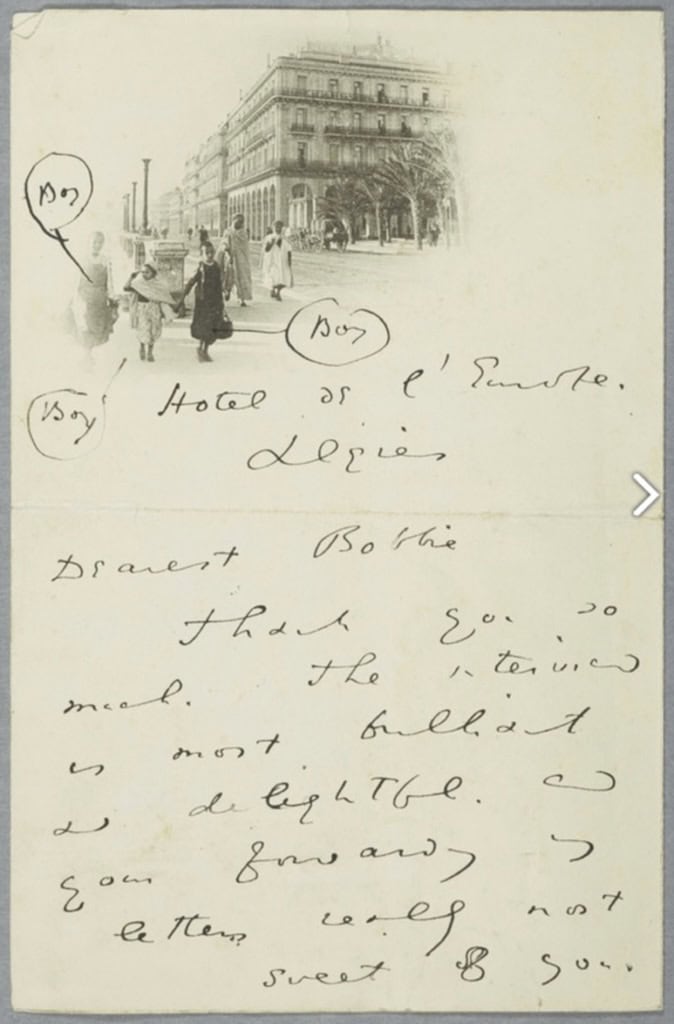
Writing to Robbie Ross from Algiers, Wilde’s annotations to the hotel letterhead and his comments barely disguise the travellers’ intentions:
There is a great deal of beauty here. The Kabyle boys are quite lovely. … Bosie wakes up at night and then cries like a child for the best haschish.
We have been on excursions into the mountains of Kabylie – full of villages peopled by fauns. Several shepherds fluted on reeds for us. We were followed by lovely brown things from forest to forest.
The beggars here have profiles, so the problem of poverty is easily solved. (Oscar Wilde, Letters, p. 381).
The last line echoes Wilde’s aphorism published in The Chameleon: ‘If the poor only had profiles there would be no difficulty in solving the problem of poverty’ and alludes to one of Wilde’s favourite biblical paradoxes: ‘Blessed are the poor’. For Wilde, ‘profile’ referred to the boys’ facial outlines, evoking their aesthetic beauty and erotic appeal. ‘Fauns’, ‘shepherds’, ‘lovely brown things’ and ‘beggars’ were likewise all coded terms which Ross would have understood.
In Blidah, a hill station south of Algiers, described by Wilde biographer Richard Ellmann as ‘much frequented by Englishmen in search of boys’, they encountered André Gide, whose autobiography If It Die (1926) infamously recalled Wilde arranging ‘a little musician’ for Gide’s pleasure. Who was Virgil and who was Dante in this underworld? Wilde laughed at the puritanical Gide’s downfall and Bosie declared ‘I hope you are like me: I hate women. I like only boys. Since you’re with us this evening, I’d rather tell you so straight away.’
Gide touted the charms of Biskra, where he had spent four months the year before, but Wilde had to return to London for rehearsals of The Importance of Being Earnest. Gide was then left with Bosie as his travelling companion. A photograph in the Catherine Gide Foundation shows Ali, ‘the companion of Lord Alfred Douglas in Biskra’, captioned in Gide’s handwriting. Gide, grappling with his soul, along with the depraved Bosie and Ali all spent two weeks in Biskra in February before going their separate ways.
Gide’s memory, confessional and self-serving, is at pains to correct Douglas’s own ‘tinctured version’ in Oscar Wilde and Myself (1914), where he denies his homosexuality, repudiates Wilde, and sees himself as a victim of calumny. Gide initially did the same and only came round to admitting his own pederasty when the Wilde scandal had abated. Their competing memories looked back on youth from middle age and adjusted the rear-view mirror. Gide’s letters to his mother present Wilde and Bosie as ‘compromising’ and ‘depraved’, comparing them to Verlaine and Rimbaud, while naturally omitting his own one-night stand with a little musician Wilde helped him pick up in the back streets of Algiers. Gide refers to ‘a horror of evil and debauchery’ and informs his mother that ‘Lord Douglas travels with a little Arab boy of about twelve or thirteen, whom he picked up in Blida’.
Thirty years later Gide described Ali in If It Die:
He was not sixteen, but how stately his bearing, how proud his glance! What condescending smiles he bestowed on the hotel servants as they bowed before him! How soon he had realised that, humble as he had been the day before, it was now for him to come into the rooms first, to sit down first […] Ali was certainly very beautiful; fair complexioned, with a smooth brow, a well-formed chin, a small mouth, rounded cheeks, and the eyes of a houri.
Bosie was keen to have Gide along as company since Ali didn’t speak French. Man and boy had known each other all of a day. Bosie had bought him fancy new clothes and come to an arrangement with the authorities and presumably his parents in Blidah to allow the boy to travel. Picking up poor boys for cosplay, elevating them to the fantasy world of the john, has a long lineage in homosexual and heterosexual liaisons: Eliza Dolittle and Lady Muck, Cinderella and The Prince and the Pauper exemplify the rags to riches story. Writing to Robbie Ross, Bosie displays the same manipulative petulance and tendency to create scenes already evident in his dealings with Wilde and partly responsible for the dramatist’s downfall:
Oscar will have told you that I am held fast by the lasso of desire to a sugar-lipped lad. He is of extraordinary personal beauty, and is aged fourteen. In fact, between me and you, his sugar has not yet been wiped by the nurse from milk. I constantly compare my boy to a gazelle. […] My boy, Ali, insisted upon wearing an old pair of trousers, I having just, at vast expense, bought him two new pairs. Words followed (through the interpreter, who speaks moderate French), and finally I told him that I had seen another boy named Achmet who was far more like a gazelle than he was […] This completely overcame my boy who lay on his bed and wept for two hours […] Finally, we made it up and had each other, as we have done every single day since I brought him from Blidah ten days ago (sometimes twice). […] I am far too occupied with Ali to look at anyone else, and Ali has sworn to stab me if I have any other boy. … I am really having a splendid time. (Cited in Neil McKenna, The Secret Life of Oscar Wilde, New York: Basic Books, 2003, pp. 329-30).
Bosie suspected Ali of making eyes at the Ouled Nail dancing girls—boys he didn’t mind—and they came to blows. Ali packed his bag and got back on the train to Blidah, while Bosie returned to London. Wilde had written informing him of the latest provocation from his father, the ‘screaming, scarlet Marquess’. On 14 February, opening night of The Importance of Being Earnest, ‘all Scotland Yard—20 police’ guarded the theatre and a bouquet of turnips and carrots was sent to Wilde by Bosie’s father.
Wilde has had the last laugh—still in print, treading the boards and reputation burnished as a queer panjandrum in an age of Good Gays / Bad Gays. Bosie, the mad bad cad, converted to heterosexuality and Catholicism, and remains unread. Gide’s mother died a few months after the events in Biskra of 1895 and he married his cousin, and promptly took her off to North Africa on their honeymoon to show her the sights. Always adept at fudging boys’ ages, mixing memory and desire and framing moral quandaries, Gide was awarded the 1947 Nobel Prize in Literature for his ‘fearless love of truth and keen psychological insight’. All that remains of Ali—poor, marginalised, pretty, tricked out in his Arabian Nights gladrags—is his picture in the archives and some fine writing in Gide’s memoir.


NOTCHES: (re)marks on the history of sexuality is licensed under a Creative Commons Attribution-NonCommercial-NoDerivatives 4.0 International License.
Based on a work at www.notchesblog.com.
For permission to publish any NOTCHES post in whole or in part please contact the editors at NotchesBlog@gmail.com


Fascinating piece — many thanks! One very small point — in the letter from Wilde to Ross, I believe the word left as a dash in your transcription is “brilliant”.
John Gilmore.
Thanks for your comments. That’s correct. It should read ‘Dear Robbie’ as well. Typos!
Thanks both! I’ve updated those.
Neil McKenna’s book on Oscar Wilde is both revealing and quite shocking. Odd that his and Bosie’s behaviour especially in relation to the son of a friend goes unremarked.
I wonder how you address the question of Roger Casement in relation to his pederasty and colonialism?
I mentioned Casement in the context of ‘human zoos’ in an old blog post from 2011, which you can find here: https://padraigrooney.com/blog/the-human-zoo/
The two Peruvian boys, Omarino and Ricudo, that Casement brought to Europe were indeed keen to get home to the forest. I dealt with their movements after getting back to Iquitos in a chapter of my Black Diaries book. They were well treated in England and Casement, although he admired the older’s body in his diary entries, did not misbehave with him.
Thanks Jeff Dudgeon. That’s my lay person’s point of view too. It raises the larger point of how we ‘judge’ gay history, desire, human power and frailty with the yardsticks of the present. How judgy-judgy do we want to be? These are concerns in my Gide research too.