Stephen Brogan
In May 1981 DJ Nicky Price opened Bolts, one of the most popular and high-profile gay clubs in 1980s London. It was a bastion of the new up-tempo Hi-NRG electro dance music that showcased cutting-edge acts, including two American cult stars, the extraordinary drag queen Divine, and the androgynous queen of disco, Sylvester. Bolts was part of a triumvirate of big, commercial gay clubs in the capital, alongside West End giants Bang (which was held at Busby’s on Tottenham Court Road, and opened in 1976) and Heaven (in Charing Cross, which opened in 1979). All three garnered endless media coverage because they forever transformed gay nightlife, which had previously consisted just of dancing to chart music in small bars. By contrast, the new nightclubs were huge, and they had their own dance music and state-of-the-art sound and light systems, all based on New York’s clubs.
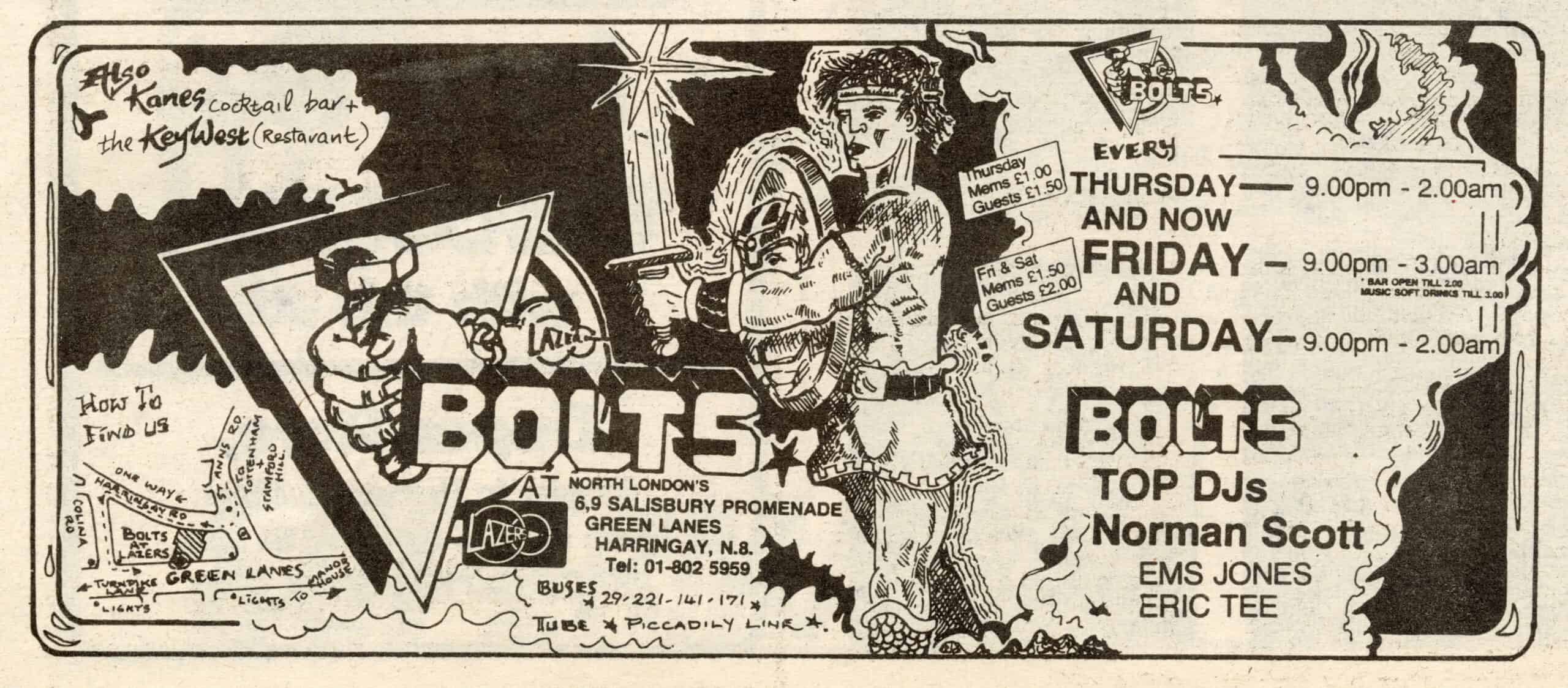
Bolts brought gay clubbing to north London. It was open on Thursday, Friday and Saturday nights, at a new venue called Lasers, in Harringay, that was voted the best club of 1981 by Disco International, thanks to its ‘smart, futuristic décor’(Time Out, 1-7 January 1982). Nicky Price and his team saw themselves and their patrons as ‘one big Bolts family’ and so entrance fees and drinks prices were kept low to encourage revelry. On its busiest evenings Bolts could attract 1,000 people.

Bolts’ sense of community was reflected in its inclusive door policy, which welcomed clones, moustachioed casuals, lesbians and drag queens, and made the club a haven for LGBTQ people seeking a safe and fun night out. In addition, the club was a sanctuary for others who risked abuse in straight venues: punks, goths and gender benders frequented Bolts, regardless of their sexual orientation, as did socially liberal straight men and women. A smattering of West End trendies, rent boys and suit-and-tie Johns added to the mix, while the presence of women contrasted with Heaven’s strict ‘men only’ weekend rule. Overall, the club had a strong cosmopolitan and working-class character, the former due to the local Greek Cypriots who partied there.

People flocked to Bolts to dance to the newest Hi-NRG disco from DJ Norman Scott, who had cut his teeth at Bang. As Nicky Price recalled recently, ‘Norman was one of a kind. He was old school, not a deck wizard or a super mixer … he was a wild, passionate, personality DJ who knew how to leave his audience on a high.’

Norman was also part of London’s new Music Pool, a system whereby record companies sent prominent DJs pre-release acetates of new songs to test on their crowds, after which they gave feedback to the companies.

DJs such as Norman, then, played a key role in creating a new phenomenon: a record that was a club hit. They included the best new records in their sets and promoted them in the press. Norman’s high profile helped to shift the status of the club DJ from that of an ordinary employee to a cult figure, along with other spectacular gay DJs such as Heaven’s Ian Levine.

Every week there was a show at Bolts. Pop stars, one hit wonders and no-hit wonders, drag queens, strippers, fire eaters, dance troupes and snake charmers all pulled in the crowds. A whole host of Hi-NRG and disco stars performed, including Sylvester, Sharon Redd, Micquel Brown, The Weather Girls, Carol Jiani, Evelyn Thomas, Marsha Raven, Latoya Jackson, Hazell Dean, and Wham. For some, their club hit would then cross over into mainstream chart success, Evelyn Thomas’ High Energy being an exemplar.

Top of the list, however, was the legendary American drag queen Divine, who appeared regularly at Bolts. An underground star throughout the 1970s on account of her mesmerising roles in filmmaker John Waters’ dark comedies, Divine toured the world as a punk-disco superstar. She guaranteed a full house because she electrified audiences with a string of international hits and the filthiest banter around. Her chart success with You Think You’re a Man, which included an appearance on Top of the Pops in July 1984, is un-thinkable without her having first built up a huge cult following in clubs such as Bolts.

The close relationship between Bolts and numerous Hi-NRG artistes and their producers paved the way for the club’s own record label, Bolts Records, founded in 1985. Its biggest hit was Male Stripper, by the New York band Man 2 Man meets Man Parrish. This was a club anthem throughout the autumn of 1986, and then in early 1987 it crossed over and spent five weeks in the UK top ten, peaking for a fortnight at number 4.

The huge success of Bolts led to Nicky Price opening regional Bolts clubs across the South East and the Midlands. The first was in Brighton, opening a mere six months after the launch of the London club. Sylvester performed regularly there, to rave reviews. Bolts clubs then opened in Hammersmith, Bournemouth, Southampton, Exeter, Bedford, Luton, Oxford, Nottingham and Birmingham. ‘Bolts was the biggest gay-club company in Britain!’, Nicky Price recalled with pride. The enterprise transformed gay club culture in the provinces, something that neither Bang nor Heaven ever achieved.

The Bolts family’s strong sense of community meant that the club undertook substantial fundraising for gay charities. Within its first year there were benefits for The London Lesbian and Gay Switchboard. Its second year saw the start of the AIDS crisis, and throughout the 1980s Bolts held fundraisers for the Terence Higgins Trust, to raise money for research into AIDS.

One such early fundraising event from March 1983 was included in the BBC Horizon documentary on the disease, with both the club night and the television programme being widely covered in the gay press.

Bolts closed in 1991, for reasons that are depressingly familiar. AIDS decimated the Bolts family — staff, patrons and performers. The rise of house music eclipsed Hi-NRG. Soho transformed itself into London’s gay epicentre, which did wonders for West End clubs, but nothing for Bolts, away in Harringay. But over its lifetime the club had made important and sustained contributions to gay nightlife, culturally (music and entertainment), technologically (sound and light systems), and philanthropically, that continue to resonate today. It belongs in London’s pantheon of gay clubs, alongside Bang and Heaven, deserving to be remembered not least for importing some of the finest gay American pop culture into north London.
The author thanks Nicky Price for his help and encouragement with this article. For their generosity in providing photographs, the author thanks Eric Demetriou, the in-house photographer at Bolts, and Stefan Dickers at the Bishopsgate Institute. Many of these images are hitherto unpublished and they provide a valuable record of Bolts.


NOTCHES: (re)marks on the history of sexuality is licensed under a Creative Commons Attribution-NonCommercial-NoDerivatives 4.0 International License.
Based on a work at www.notchesblog.com.
For permission to publish any NOTCHES post in whole or in part please contact the editors at NotchesBlog@gmail.com


I loved reading this post about Bolts. Thanks for doing such in-depth research and sharing it. I went there many times in the 1980s and always had fun dancing and meeting new men. I seem to remember that it was at the corner of Seven Sisters Road and Green Lanes – conveniently right across the street from the Manor House tube station. I wonder if the building where Bolts was is still there.
The photo of Pickle (Phil Bakal) smiling with George Michael in the foreground brought a tear to my eye. I met Pickle in 1977 and he and I went out together for awhile, remaining friends for many years. Pickle was the first friend of mine who died of AIDS. I will remember him forever. In my diary, I found an entry that said that on Sunday, November 24, 1985, I was at Bolts for a memorial service for Pickle. It was such a beautiful gesture on the part of the management and staff to hold that service for him there – the perfect setting.
Many thanks for your lovely comment. The Pickle memorial fits with the strong sense of family among the Bolts team, and brings a tear to my eyes. I believe the building is now a Tesco! Update: it’s a gym above a Tesco Express on Green Lanes.
I want to say as a member of the Bolts’ staff and family, many of us are still connected and in touch with each other. We have more stories than can be mentioned, all great stories, weird stories, Murder stories, don’t read too much into that one. Fun stories, heartbreaking and bitchy stuff. (Something’s never change) A great breakdown of the beginning and the end. Boy, we could fill the middle and make a great book out of this. Who wants to be the author to put it all together?
I loved reading this article, thanks. I lived in North London in 1981 and loved going to Bolts – there was a really good atmosphere, good mix of people and the music was great. I remember pyrotechnics being set off in the ‘dome’ above the dancefloor when they played ‘Don’t Stop the Train’ (unless my memory is playing tricks on me – that happens now I’m in my 60’s)
Love this read. So many flashbacks!
Thank you