Jordan Biro Walters
In 1938, an aspiring artist Agnes “Agi” Sims travelled to Santa Fe looking for lesbians. She had met some like-minded women in East coast artistic circles, but it was not until her trip to Santa Fe that she found a place to be both an artist and a lesbian. She moved to the art colony where she purchased a home for herself and long-time partner, Mary Louise Aswell. In their home, they mentored and nurtured a coterie of lesbians to such a degree that their efforts garnered the city’s reputation as what Truman Capote described as the “dyke capital of the United States.”

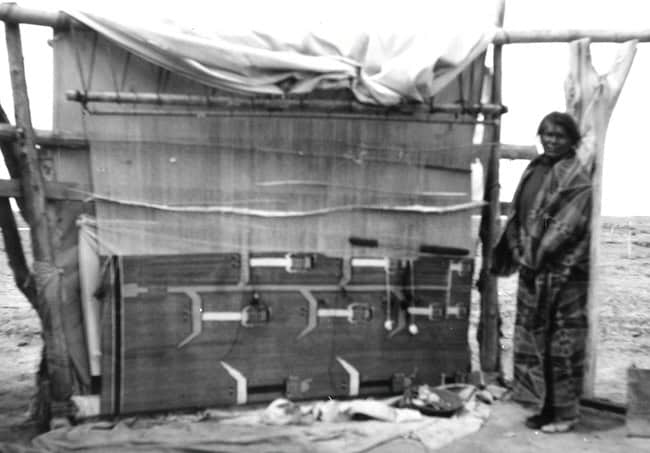
Another queer participant of northern New Mexico’s art colonies, Hastíín Klah (Diné/Navajo) reveals a different experience. Unlike the white queer bohemians who used migration out of their hometowns to explore their sexual identity, Klah’s return to Diné ancestral lands initially fostered their nádleehí status, a genderfluid identity. While some Diné children were forced to attend a government school or missionary establishment, Klah was educated at home. This enabled Klah to embrace being nádleehí, which included occasional wearing of cross-gender attire. As a young adult, Klah’s occupational choices further indicated their nádleehí status. They produced art as a weaver, at the time considered the domain of women, and combined this with their religious practices as a hatałii (ceremonial singer), a male role. Because of this combination, Klah made art, textiles with ceremonial designs, from a nádleehí perspective. By the end of their life, their gender variance became increasingly constrained by settler colonialism. Klah wore only male attire after facing harassment from a new generation educated through government schools. At a time when queer spaces for white artists and writers widened, sensibilities of nonbinary gender and homoeroticism for Navajos, Pueblos, and Nuevomexicanos narrowed.
Wide-Open Desert: A Queer History of New Mexico unearths how the state became a site of queer possibility in the 1920s through 1980s—but not equally for everyone. I approach my research through an intersectional lens. I searched for Indigenous, Nuevomexicano, lesbian, gender-queer, and rural queer peoples’ voices to demonstrate the complex development of queer belonging in the desert. Wide-Open Desert argues that geographic mobility and the discourse and diffusion of queer creative productions are the foremost elements that shaped queer cultures and politics in the American Southwest.
The book began as a dissertation at the University of New Mexico in Albuquerque. Unlike the state I grew up in, California, which has two renowned queer archives, New Mexico lacked an LGBTQ+ archive. Finding the lives of sexual and gender nonnormative New Mexicans was a challenging task. I started by conducting and collecting oral histories. I learned from my first co-collaborators, Barabara Korbal and Bennet Hammer, that they had begun an effort to develop a queer archive in New Mexico. At that time, records sat in a storage unit awaiting processing and a home. I joined their endeavor and spearheaded the oral history arm of the Bennett Hammer LGBT Collection. I also guided the project to one of its institutional homes the Center for Southwest Research at the University of New Mexico Libraries.
Pairing oral histories and creative pieces by queer people with archival collections, government documents, university records, and newspaper articles reveals how queer cultural development overlapped with and inspired the beginning of sexual politics in New Mexico. In a state that had far fewer incidents of police brutality, bar raids, entrapment, and street harassment, queer New Mexicans spent less time countering anti-gay acts and instead asserted their queer lives through cultural production and defending their right to make and share such works.
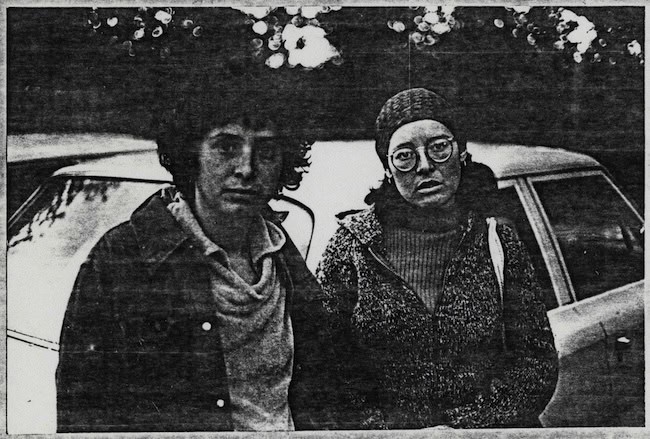
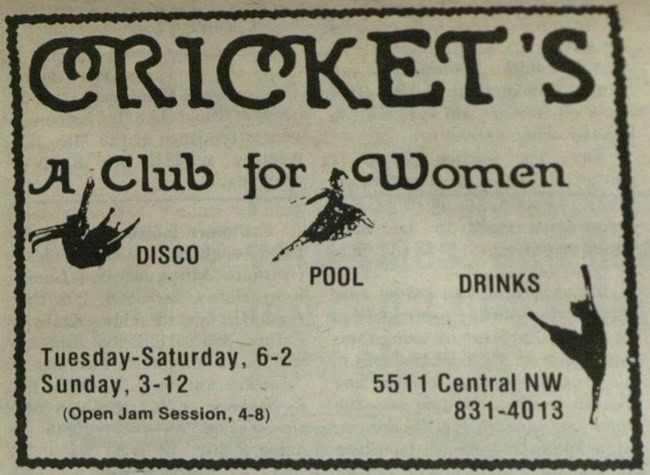
By the 1970s, queer cultural politics had moved from art colonies into campuses, bars, and visual and print culture. The partnership of Cecilia and Marilyn demonstrates this point. Both attended the University of New Mexico and became politically active through Las Chicanas—an informal rap group of Chicana activist students. Although they met through Las Chicanas, it wasn’t until they saw each other at the lesbian bar Cricket’s that their relationship began. The two privately developed a lesbian relationship, which they kept hidden from Las Chicanas due to anti-lesbianism in the group. Both expressed that within the Chicano movement and gay liberation politics, Chicana lesbians lacked visibility. Cecilia and Marilyn, who felt silenced, found agency by agreeing to appear in the documentary film Word Is Out: Stories of Some of Our Lives (1977). While their narrative was not selected for the final version, their decision boldly challenged the censure of their same-sex expression. Word Is Out, the first feature-length documentary about lesbian and gay identity made by gay filmmakers, provided a venue for articulations of Chicana homoeroticism.
Lastly, the 1980s ushered in an era of critical interventions from queer people of color and anthologies served as alternative sites of queer knowledge production. Cofounder of Gay American Indians (GAI) Randy Burns (Northern Paiute/Pyramid Lake Indian Tribe) and Chair of the GAI Board of Directors Erna Pahe (Diné/Navajo) spearheaded the endeavor to create Living the Spirit—the first anthology devoted to the cultural productions of two-spirit and gay American Indians. GAI and its anthology reclaimed tribal formations of gender and sexual variance for Native people. The organization, located in San Francisco, California, further encouraged Native people to come out through the Native urban queer community and, if possible, “the Indian community.” Many queer-identified Native people left reservation life to embrace sexual identity, as Pahe did. Pahe, at the age of twenty-two, moved to San Francisco, came out as gay, and took a leadership role in GAI. In an oral history, Pahe expressed that gay Navajo people could live quietly on parts of the Navajo reservation, but she chose to migrate because it permitted her to be “vocal” and visible.
The ability of an individual to move for queer association is a right and often a necessary step in embracing a queer self. Building on the identity formation process, queer creatives established networks that cultivated knowledge about queerness. Queer discourse served as an organizing principle during the modern gay liberation movement; queer New Mexicans significantly contributed to it. Wide-Open Desert tells many more stories, but it is far from a complete history.
At a moment when queer history is again under attack, recovering these stories matters. The more fully we know the queer past—in every region of the United States—the harder it becomes to erase LGBTQ+ people in the present.
Source Note: Gay American Indians, “Chicago Resource Center Grant Proposal 1983 to 1985,” box 1, folder 7, and Erna Pahe, interview, July 17, 1985, transcript, box 1, folder 1, Will Roscoe Papers and Gay American Indians Records, 1987-04, Gay, Lesbian, Bisexual, Transgender Historical Society, San Francisco.


NOTCHES: (re)marks on the history of sexuality is licensed under a Creative Commons Attribution-NonCommercial-NoDerivatives 4.0 International License.
Based on a work at www.notchesblog.com.
For permission to publish any NOTCHES post in whole or in part please contact the editors at NotchesBlog@gmail.com


